
TradeIQ. Market intelligence and trading decisions, connected.
TradeIQ brings real-time and historical market data, AI-powered short-horizon forecasting, configurable algorithmic trading bots and connected trading workflows into one workspace.
Analyze the market, review model signals, define your trading parameters and move from insight to action with fewer disconnected tools. The platform is designed for cross-asset intelligence spanning cryptocurrency, foreign exchange, stocks and energy, with cryptocurrency trading at the center of its demonstrated experience.
Trading is complex enough. The tools should not make it harder.
To evaluate one market move, a trader may need price charts, historical data, technical indicators, breaking news, model forecasts, trading controls and exchange access. When that information is scattered across different applications, every decision requires more effort than it should.
Fragmented Market Context
Charts, market news, order books and trading controls are often spread across separate interfaces. The full picture becomes harder to see.
Signals Without Context
A forecast is only one part of a decision. Traders also need to understand its timeframe, relevant market behavior and available performance history.
Automation Without Boundaries
Trading automation should reflect a defined strategy. Order sizing, price limits and loss thresholds must be adjustable to fit the user’s rules.
From live data to an informed trading action.
Monitor
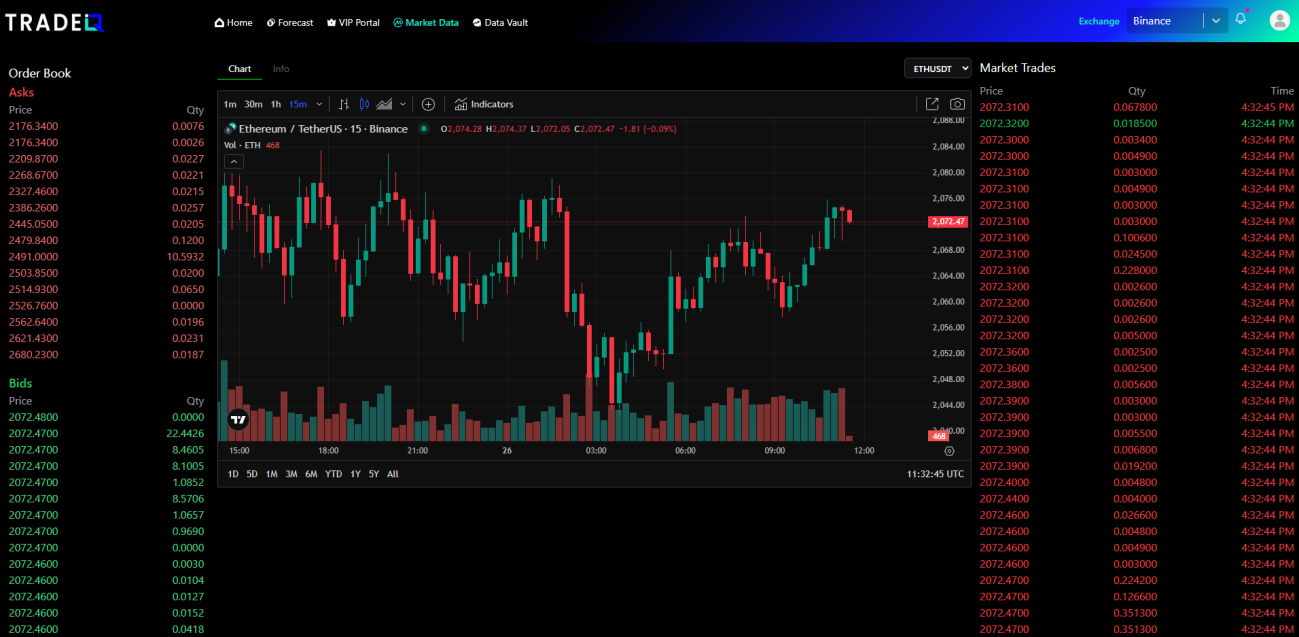
Review market feeds, charts, historical trends, indicators, news and order-book information.
Forecast
Explore machine-learning forecasts across 15, 30, 45 and 60-minute windows.
Configure
Assess model signals, define bot parameters and establish order and risk limits.
Execute
Use supported exchange connectivity to place orders and review trading history.
One workspace. Several ways to read the market.
Explore the capabilities that bring market analysis, predictive intelligence and trading workflows together. Each view keeps relevant information close to the action it informs.
A live view, with the history behind it.
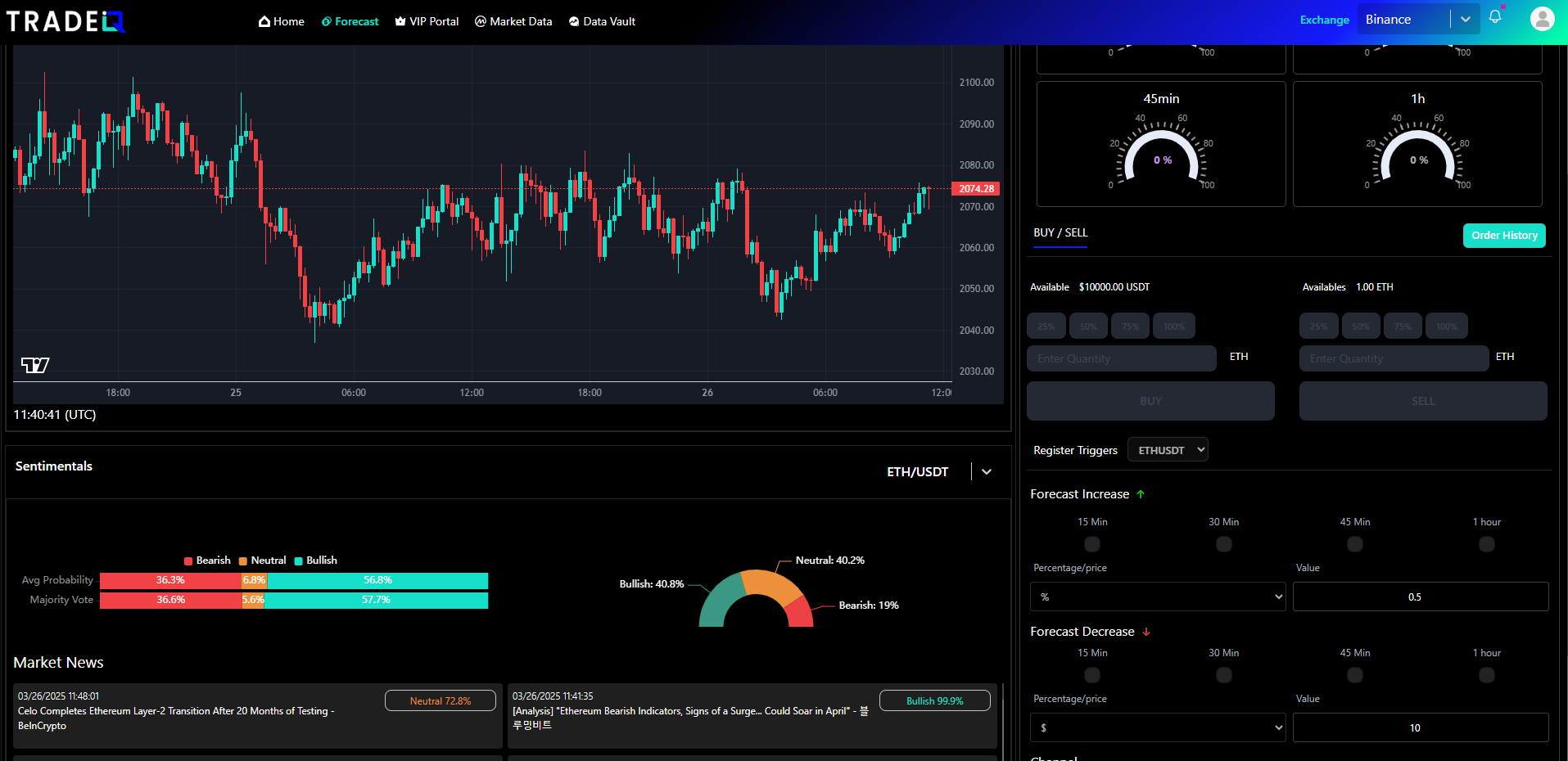
TradeIQ combines live price information with historical charting, market trends and technical indicators. Cryptocurrency views include exchange market data and order-book information, while news and sentiment panels add context to changing conditions.
Traders can inspect different signals within one environment instead of moving between multiple windows.
- Real-time and historical market data
- Technical indicators and charting
- News, sentiment and exchange order-book views
Short-horizon forecasts you can inspect.
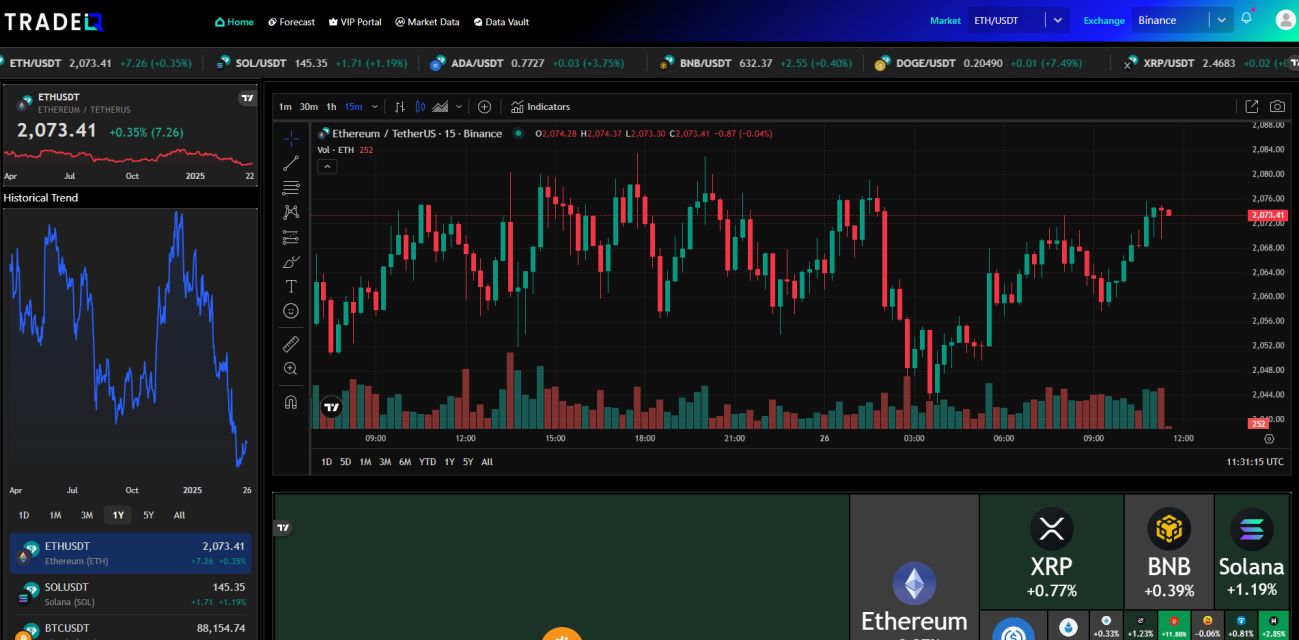
TradeIQ uses machine-learning models to generate forecasts at 15-, 30-, 45- and 60-minute intervals. These outputs are visualized alongside market charts, with forecast indicators and historical performance views designed to help users interpret model behavior.
The purpose is to make predictive information easier to evaluate—not to promise a certain market outcome.
- Four near-term forecast windows
- Visual forecast and confidence indicators
- Historical forecast-performance views
Forecast indicators are illustrative. They do not guarantee future market outcomes.
Set the strategy. Set the boundaries.
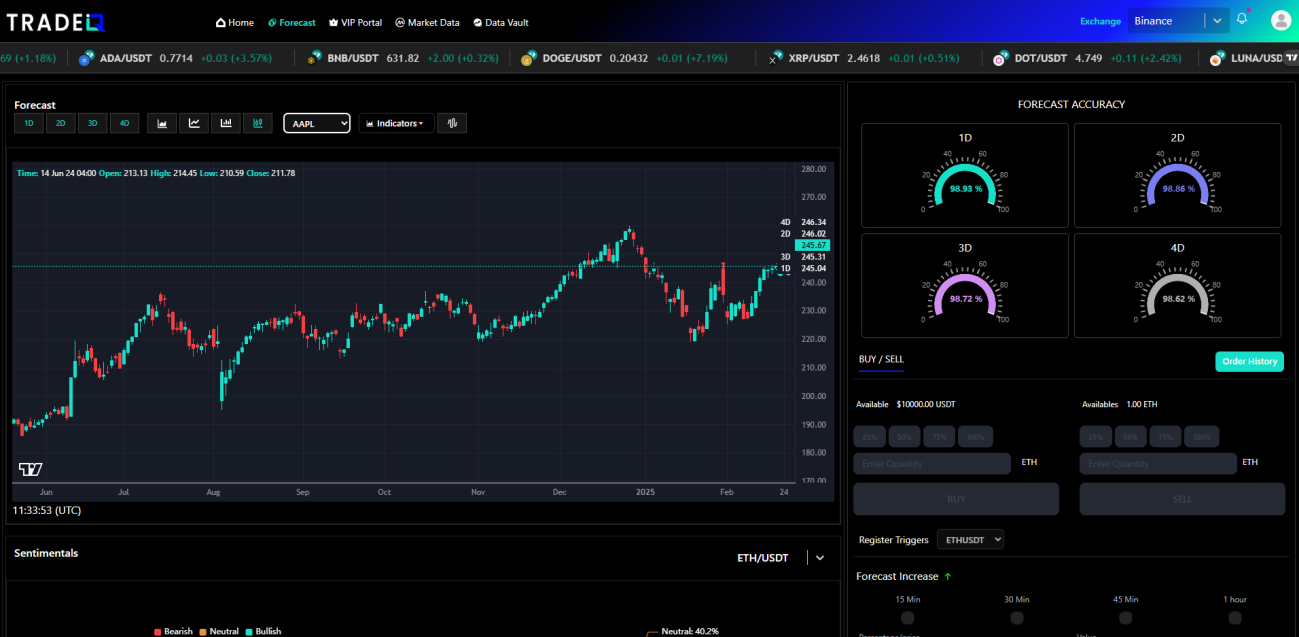
TradeIQ includes configurable algorithmic trading bots designed to respond to defined market conditions. Traders can tailor settings such as minimum and maximum order sizes, price boundaries and loss limits to fit their own trading approach.
The platform also describes backtesting strategies against historical data before deploying them in a live trading environment.
- Configurable bot and order parameters
- Adjustable price and loss boundaries
- Historical strategy testing and monitoring
From analysis to action, without the detour.
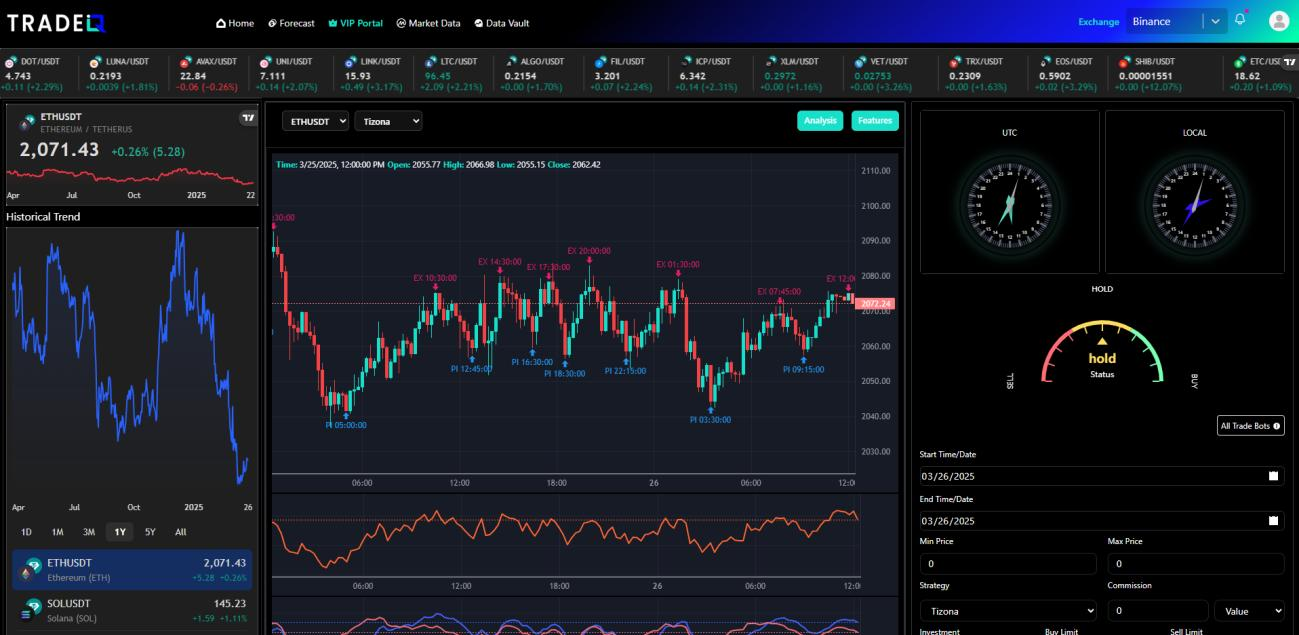
TradeIQ brings exchange connectivity, order controls and trading history into the same broader workspace as its market intelligence. Its cryptocurrency experience includes Binance-focused market-data and trading interfaces.
Telegram trigger notifications provide another way to stay aware of important market movements and events beyond the dashboard.
- Exchange API connectivity and trading interface
- Order entry and order-history views
- Telegram trigger notifications
Forecast. Evaluate. Configure. Execute.
TradeIQ is designed to reduce the distance between market information and the workflow that follows. Its value is not a prediction in isolation—it is the ability to see data, model outputs and user-defined trading rules together.
Good technology takes more than one kind of engineer.
Useful products are built where business understanding, product judgment and deep engineering meet. A polished interface matters—but so do the data foundations, system architecture, integrations, testing and decisions behind it.
OdyxAI brings these disciplines into one coordinated delivery approach, aligning the people defining the problem with the specialists designing, engineering, validating and evolving the solution.
Product Strategy & Experience
Product discovery, user journeys, requirements, prioritization, UX design and interfaces that make complex workflows easier to understand.
AI, Machine Learning & Data
Data engineering, predictive analytics, machine-learning workflows, intelligent automation and practical model evaluation.
Application & Platform Engineering
Frontend and backend development, enterprise APIs, cloud architecture, systems integration and scalable platforms.
Quality, Security & Operations
Testing, access controls, deployment planning, monitoring and iterative improvements beyond first release.
From a difficult problem to a product people can use.
We do not begin with a list of technologies. We begin with the job the product needs to do, the people using it and the constraints that make it difficult. From there, the work becomes a sequence of deliberate decisions: what to build, how to connect it, how to prove it works and what to improve next.
Discover
Understand the business objective, users, workflows, existing systems and measures of success. Identify what must work first—and what can wait.
Design
Translate the problem into user journeys, technical architecture, data flows, integration plans and an actionable roadmap.
Engineer
Build in testable increments. Connect interfaces, intelligence, data and APIs while validating against real use cases.
Evolve
Support deployment, validate system behavior, study user needs and improve the product as requirements change.
The work matters after launch, too.
A product is only valuable when teams can operate it, understand it and build on it. That shapes how we approach architecture, safeguards and long-term engineering decisions.
Integration From the Outset
New products rarely live alone. We plan around the applications, data sources, workflows and APIs they must work with.
Human Judgment Where It Belongs
Intelligent systems need clear controls, review paths and sensible boundaries—especially when outputs inform consequential decisions.
Testability and Visibility
Quality is not a final checkbox. We design for measurable behavior, meaningful tests, monitoring and practical debugging.
Room to Improve
Modular architectures help teams adapt models, features and integrations as products and user needs evolve.
One engineering partner. Different ways to build.
Some teams start with a clear product idea. Others need specialist capacity or a better foundation for what they already run. We shape the engagement around the work—not the other way around.
Which markets does TradeIQ cover?
TradeIQ is designed as a cross-asset algorithmic trading platform spanning cryptocurrency, foreign exchange, stocks and energy. Its documented interfaces focus particularly on cryptocurrency, including Binance-focused market data and trading workflows. Availability of individual instruments and execution capabilities depends on the implementation.
What kinds of forecasts does TradeIQ provide?
TradeIQ provides machine-learning-based forecasting views for 15-, 30-, 45- and 60-minute intervals. Traders can review model indicators and available historical forecast-performance information alongside market charts. Forecasts are informational signals, not guarantees of future price movement.
Can traders customize automated trading bots?
Yes. TradeIQ includes customizable bot settings such as minimum and maximum order sizes, price boundaries and loss limits. Its product design also incorporates historical strategy testing. Users remain responsible for evaluating automated trading behavior and managing market risk.
How does TradeIQ connect to exchanges and alerts?
TradeIQ includes exchange API-based workflows, with Binance-focused cryptocurrency market views, order controls and order-history interfaces. The platform also supports Telegram trigger notifications for notable market conditions. Available connections and live functionality depend on the deployed configuration.
Bring us the problem. We will help define the build.
Whether you have a new product in mind or a complex platform that needs to move forward, OdyxAI brings product thinking and engineering execution together. Tell us what you are trying to solve. We will start with the right questions.

